KOAN study: tomatoes lead Kenyan market vegetables over EU pesticide limits
Key points
- Kenya Organic Agriculture Network analysed 45 samples of tomatoes, kale, spinach and onions from Nairobi and Nakuru markets.
- Residues detected in 35 samples (77.8%); 15 samples (33.3%) exceeded EU Maximum Residue Limits for eight active ingredients.
- Tomatoes had the most exceedances; onions had residues but none above EU MRLs.
- Results align with 2024 PCPB baseline work where 31% of 105 samples exceeded EU limits, tomatoes ~64% of non-compliant samples.
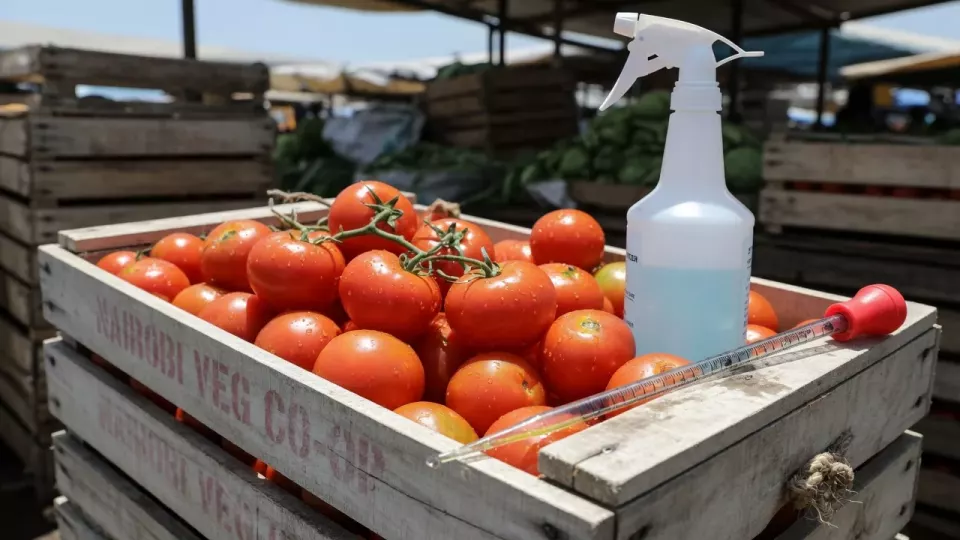
The tomato on a Nairobi or Nakuru market table is more likely than kale, spinach or onion to carry pesticide residues above European Union safety benchmarks, according to a Kenya Organic Agriculture Network (KOAN) laboratory study reported by Eastleigh Voice — a food-safety finding that starts on the farm and ends in the cooking pot.
Researchers tested 45 vegetable samples with liquid chromatography–tandem mass spectrometry and gas chromatography–tandem mass spectrometry. Pesticide residues appeared in 35 samples (77.8 per cent). Fifteen samples (33.3 per cent) contained eight different pesticide active ingredients at levels above the EU’s Maximum Residue Limits (MRLs), a signal of improper application or harvest before the pre-harvest interval elapsed. Chemicals above the limit included fungicides, insecticides, a herbicide and a miticide.
Why tomatoes dominate the risk list
Among the four crops, tomatoes contributed the highest number of samples over the recommended limits, followed by spinach and kale. Onion samples showed residues, but none exceeded EU standards — researchers link that partly to the bulb developing under soil, though herbicides used late to dry bulbs could raise risk if intervals are ignored. Tomatoes are among Kenya’s most intensively sprayed crops because of pests, fungi, nematodes and weeds; global research cited in the package estimates pest losses of about 34.4 per cent under current practice and nearly 78 per cent without protection. Year-round production and high demand may push early harvests. The study also found some active ingredients not registered for use on tomatoes, and called for stronger farmer training, extension and enforcement of registration rules.
Leafy greens retain spray on broad, waxy surfaces and are eaten whole; thorough washing, soaking, blanching and cooking can cut residues but do not replace farm-level controls. The pattern matches 2024 Pest Control Products Board baseline surveys of tomatoes, kale and onions across eight counties: of 105 samples, 33 (31 per cent) exceeded EU limits, with tomatoes about 64 per cent of non-compliant samples. Both streams detected carbendazim on leafy vegetables where it is not registered for certain uses. Health desk: Health. Verified lab counts and PCPB comparison from Eastleigh Voice; the study does not by itself ban market sales or name individual farms.
Based on Eastleigh Voice reporting of the KOAN pesticide residue study and cited PCPB 2024 baselines. Laboratory certificates and PCPB enforcement notices control regulatory outcomes.