The App Giving Kenyan Survivors of Sexual Violence a Fighting Chance in Court
When a case of sexual violence reaches a Kenyan courtroom, one of the first things a magistrate calls for is the medical evidence — the Post-Rape Care form completed by the clinician who examined the survivor. For years, that document was paper, and paper disappears. Forms were lost in transit, damaged in storage, or arrived at court so incomplete that judges dismissed charges before a single witness was heard.
Key points
- MediCapt, built by Physicians for Human Rights, lets Kenyan clinicians document sexual violence forensic evidence digitally.
- The app records injury observations, attaches encrypted photographs, and uploads to a tamper-proof secure cloud archive.
- Lost or incomplete paper Post-Rape Care forms had long caused sexual violence cases to be dismissed before verdict.
- MediCapt works offline in low-connectivity areas, syncing automatically once internet is restored.
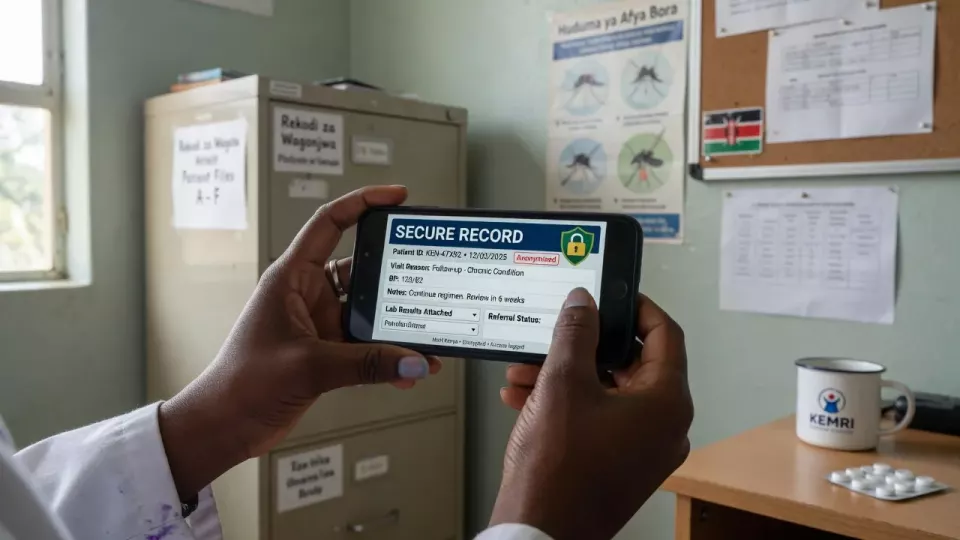
A mobile application developed by Physicians for Human Rights (PHR) is trying to close that gap. MediCapt allows trained clinicians to conduct forensic examinations and record their findings digitally — logging injury observations, attaching encrypted photographs, and uploading everything to a secure cloud archive protected by tamper-proof metadata. A record created in a Naivasha clinic can be retrieved by a magistrate in Nakuru. It cannot be altered in transit, and it cannot simply go missing.
The app was built with Kenya's realities firmly in mind. It operates offline in areas with unreliable internet, syncing automatically once connectivity is restored. Informed consent is embedded at each step of the documentation process. Survivors' identities are protected throughout. PHR worked in close collaboration with Kenyan health workers and justice sector partners during design and field testing, ensuring the tool reflected the conditions clinicians actually work in rather than the conditions engineers imagined.
According to PHR data cited by Nation.Africa, 1,854 cases have been documented on MediCapt at its Kenyan sites as of May 2026. The app is currently active at five facilities: Naivasha County Referral Hospital, Nakuru County Teaching and Referral Hospital, Mukuru Health Centre in Nairobi, Lumumba Sub-County Hospital in Kisumu, and Molo Sub-County Hospital. Between January 2024 and December 2025, 382 MediCapt-generated forms entered the justice system — a concrete measure of cases that now carry a documented evidentiary record rather than a missing piece of paper.
The practical value of that record was demonstrated at a Nakuru facility when a physical Post-Rape Care form was misplaced after an examination. Staff retrieved the digital version from the MediCapt system and reprinted it. The court accepted the document and proceedings continued — an outcome that would have been impossible under the old paper-only system.
Naitore Nyamu, head of PHR's Kenya office, has described quality forensic documentation as "a vital part of comprehensive care and access to justice." That framing captures the dual function MediCapt is designed to serve: it is a clinical record and a legal instrument simultaneously. The examination happens once; the data persists indefinitely.
In November 2025, PHR convened a roundtable in Nairobi bringing together clinicians, magistrates, law enforcement officers, government officials, and digital health specialists to review MediCapt's progress and map its next phase. Karen Naimer, PHR's Director of Programs, told those gathered that technology alone cannot deliver justice: "It is your collaboration that gives survivors a real chance at justice." The app's reach is set to extend further, with expansion to Tanzania and Iraq now in planning.
Sources: Nation.Africa.