Kenya's Real Estate Market Cools as High Interest Rates Curb Mortgage Uptake
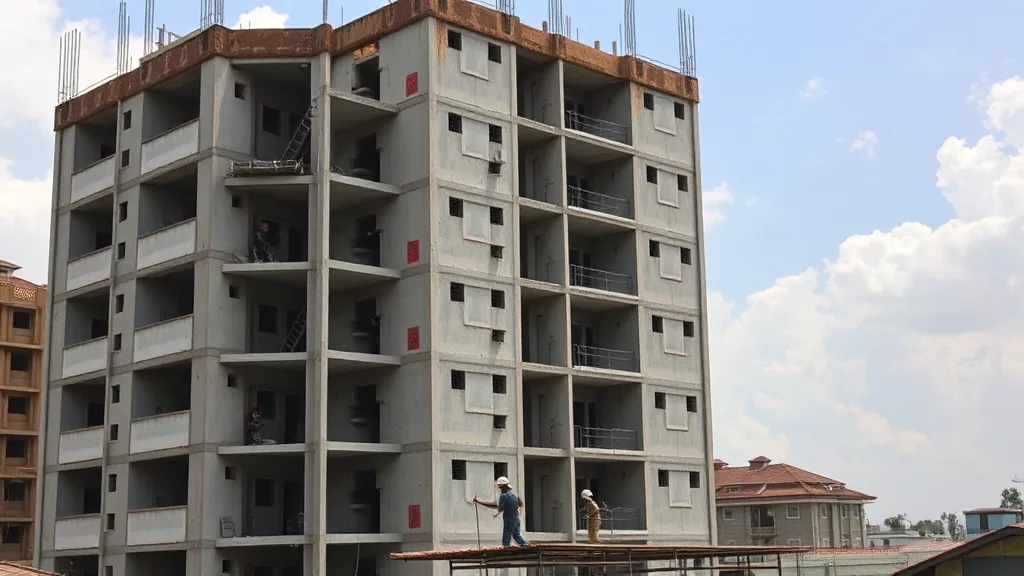
Kenya's once-buoyant real estate market has entered a pronounced cooling period, with property transactions in Nairobi falling 22% year-on-year in the first half of 2026 as persistently high commercial lending rates keep formal mortgage credit out of reach for the majority of would-be homeowners. Industry data compiled by the Kenya Bankers Association puts average mortgage rates at 17.4% as at June 2026, a legacy of the Central Bank of Kenya's aggressive monetary tightening cycle of 2023 and 2024.
The Kenya Mortgage Refinance Company (KMRC) reports that the total outstanding mortgage book across the banking sector stood at Ksh 276 billion at the end of May, up only 3.2% from twelve months earlier — its slowest growth rate since the institution's founding in 2019. New mortgage disbursements fell to 1,847 in the first five months of the year, compared with 2,391 over the same period in 2025.
Mid-Market Segment Hardest Hit
The pain is most visible in the mid-market segment — two- to four-bedroom units priced between Ksh 6 million and Ksh 18 million — which had been the fastest-growing part of the market during the post-pandemic recovery. Developers targeting this bracket, including Optiven Group, Superior Homes, and Centum Real Estate, have reported slower sales cycles and rising inventories of completed but unsold units, particularly in satellite towns such as Ruiru, Rongai, and Athi River.
Optiven chief executive George Wachiuri told ZaKenya.com that average time-to-sale for their residential plots had stretched from four months to over seven. "The appetite is there — we see inquiries every day — but the moment prospective buyers run the mortgage numbers, many step back," he said. "A Ksh 10 million mortgage at 17% over 20 years costs you roughly Ksh 153,000 a month. That is beyond what a household earning Ksh 200,000 monthly can comfortably service."
The luxury segment above Ksh 50 million has remained relatively resilient, sustained by cash buyers, diaspora investors, and corporates seeking grade-A office and mixed-use assets. Knight Frank Kenya's mid-year market update found that prime residential values in Karen and Runda had held broadly flat, while Westlands commercial office rents inched up 4% in dollar terms on account of tight Grade-A supply.
SHA Uncertainty Weighs on Household Budgets
The strained mortgage market is compounded by broader household budget pressures. The transition from the National Hospital Insurance Fund to the Social Health Authority (SHA) has introduced new monthly levy obligations — 2.75% of gross income — that have effectively reduced disposable income for salaried workers. Housing finance practitioners argue this structural change has made lenders more conservative in their debt-service ratio calculations, pushing the effective affordability threshold even higher.
KMRC chief executive Johnstone Oltetia called on the CBK to adopt a targeted mortgage refinancing rate that sits at least 300 basis points below the prevailing policy rate. "In South Africa and Morocco, government-backed mortgage refinance facilities have successfully separated housing finance from the broader credit cycle," he told a Nairobi housing forum in June. "Kenya needs the same policy separation."
Government's Affordable Housing Programme Struggles to Bridge the Gap
President Ruto's flagship Affordable Housing Programme, which aims to deliver 200,000 units annually, has picked up delivery pace after supply-chain disruptions in 2024 but still faces a financing mismatch. The 1.5% housing levy on gross employee wages continues to generate controversy, with the Kenya Human Rights Commission maintaining a court challenge over its constitutionality. As of June 2026, approximately 28,000 units under the programme were at varying stages of completion across Nairobi, Mombasa, Kisumu, and Nakuru.
Private developers are watching the CBK's Monetary Policy Committee decisions closely. The MPC held the benchmark rate at 12.5% at its June 2026 meeting, citing easing but still-elevated inflation, and analysts broadly expect one cut of 50 basis points before year-end. Even so, with commercial spreads typically adding 4.5 to 5 percentage points above the policy rate, meaningful mortgage relief remains some distance away for ordinary Kenyans aspiring to own a home.